1 The Story
The journalist who learned to measure the market
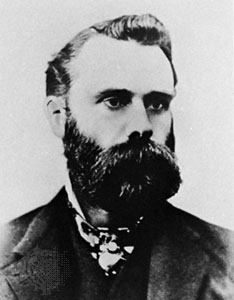
Born to a farming family in Sterling, Connecticut in 1851, Dow lost his father at six and had little formal schooling. He became a journalist and moved to New York in 1880, and in 1882 co-founded Dow Jones & Company with Edward Jones and Charles Bergstresser.1
In 1884 he compiled the first average of selected U.S. stocks — the ancestor of the Dow Jones averages — giving the market a single number that could be tracked over time. In 1889 he helped launch The Wall Street Journal and served as its first editor until his death in 1902.1
Here's the twist that makes Dow unusual on this site: he never traded a system, never used the term "Dow Theory," and never wrote a book. His ideas lived in some 255 editorials. Only after his death did William Peter Hamilton and Robert Rhea organize those editorials into the tenets studied today.2 Dow's gift was a way of seeing the market — and the instruments to watch it with.
2 The Big Idea
The market can be measured — and it moves in trends
Read the weight of evidence; a trend persists until proven otherwise.
Dow's leap was to treat the whole market as a measurable thing — an average you could track — and to notice that it moves in trends made of higher highs and higher lows, in tides, waves, and ripples. You don't predict the turn; you give the trend the benefit of the doubt and change your mind only when the market itself changes. Almost every method that followed — Wyckoff, Elliott, modern price action — is a descendant of this idea.2
3 The Method — Dow Theory
The six tenets, in plain language
Dow Theory is the framework Hamilton and Rhea drew from Dow's editorials. Its core pieces:2
Three trends at once — tide, waves, ripples
The market makes three movements together: the primary trend (the tide, months to years), secondary reactions (the waves, counter-trend moves retracing ~1/3–2/3), and minor ripples (days, mostly noise). Know which tide you're in first.
The averages must confirm each other
Dow paired an industrials average with a railroads average: if factories prosper, their goods must ship, so the rails should prosper too. A rally in one not confirmed by the other is suspect — a divergence is a warning the trend may be changing.
Volume confirms the trend
Volume should expand in the trend's direction. Rising prices on rising volume confirm a healthy move; rising prices on fading volume warn of weak conviction.
Trends move in three phases
A bull market runs through accumulation (the informed buy quietly), public participation (the big, fast move as the crowd piles in), and distribution (the early buyers sell to the late crowd). Bear markets mirror it in reverse.
The market discounts everything
Prices absorb all available news almost as soon as it appears — agreeing, on this point, with the efficient-market idea. You can't easily profit from what the market already knows.
A trend holds until proven reversed
Markets wander on noise, but a trend gets the benefit of the doubt until clear evidence — divergence, a structural break, volume — says it has actually turned. Telling a true reversal from noise is the hard part.
4 Try It Today
Test the idea for yourself
A no-risk exercise
Pull up a major index (say the S&P 500) on the daily timeframe. Mark the last few primary swing highs and lows and label the trend bullish, bearish, or sideways. Then open a related average — the Dow Transports or a key sector — and check whether it confirms the same trend or diverges.
Add volume and note whether it expands in the trend's direction. Finally, write one sentence stating what the weight of evidence says — and the specific event that would change your conclusion. (This connects to the Masterclass "Dow Theory" module.)
5 In Their Words
Dow, quoted
"The market is always to be considered as having three movements, all going on at the same time."— Charles Dow, from his Wall Street Journal editorials, as compiled in the Dow Theory literature2
A note on sourcing: Dow expressed his ideas in newspaper editorials, not tidy aphorisms or a book. Many famous "Dow Theory" lines — like the tide-waves-ripples analogy — were actually coined by William Peter Hamilton, who popularized and organized Dow's thinking. We attribute carefully rather than put neat quotes in Dow's mouth.
6 The Books That Codified Him
Dow wrote editorials — these two turned them into a method
Dow never published a book; his ideas survive because two followers organized them. Both are the foundation of technical analysis.
The Stock Market Barometer
William Peter Hamilton · 19227 Watch & Read
Go deeper

- BOOKThe Stock Market Barometer — William Peter Hamilton (1922).
- BOOKThe Dow Theory — Robert Rhea (1932).
- READ"Charles Dow" & "Dow theory" — Wikipedia overviews.12
- COURSEMasterclass: the "Dow Theory" module
§ Sources
- "Charles Dow," Wikipedia — en.wikipedia.org/wiki/Charles_Dow
- "Dow theory," Wikipedia — en.wikipedia.org/wiki/Dow_theory
- "Charles Henry Dow," Encyclopædia Britannica — britannica.com/biography/Charles-Henry-Dow