
1 The Story
The teacher behind “Lane’s Stochastics”
George Lane spent his career popularising and teaching the Stochastic Oscillator — so effectively that it carries his name, even though he was part of a group that developed it.
Lane began a roughly 50-year career in the markets at the brokerage E.F. Hutton & Co. in the 1950s, and his broker’s training included time under the tape-reading pioneer Joseph Granville. He later joined the research group at Investment Educators Inc. in Watseka, Illinois — the firm he would eventually own and run as president, teaching investors and professionals basic and advanced technical analysis for decades.1
The Stochastics work dates to the late 1950s and a circle of Chicago futures traders; Lane became its great popular teacher, so much so that the tool is still called “Lane’s stochastics.”25 An honest note on attribution: in 1986 John Murphy wrote the oscillator was “invented by George Lane,” then revised it in 1999 to “popularised by George Lane” — Lane himself acknowledged he was part of a group, not a sole inventor.1
2 The Big Idea
What they gave the markets
Where the close sits in the range, scaled 0–99 — and what divergence reveals.
Lane taught that the most valuable signal is not a raw overbought/oversold reading but a divergence between the oscillator and price — he called a %D divergence the “only signal which will cause you to buy or sell.”2
3 The Method & Contribution
What he taught
The oscillator
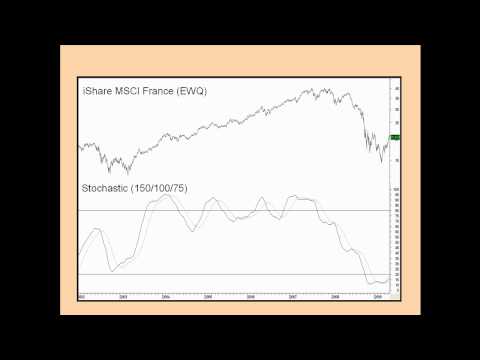
%K measures the close’s position in the recent high–low range; %D smooths it.2
Divergence first
His emphasis: price making a new extreme the oscillator fails to confirm.2
Set-ups & set-downs
His framework for anticipating turns, beyond simple band readings — the bull and bear “set-ups.”2
Honest attribution
He popularised, more than solely invented, the tool.1
4 In Their Words
Momentum turns before price
“Stochastics measures the momentum of price. If you visualize a rocket going up in the air — before it can turn down, it must slow down. Momentum always changes direction before price.”— George Lane, describing his indicator (Stocks, Futures and Options Magazine, March 2007).3
In his own teaching manual he put the same idea mechanically: “As prices move down, the close of the day has a tendency to crowd the lower portion of the daily range… the closes no longer crowd the bottom of the daily range. Therefore, Stochastics turns up at or before the final price low.”4
5 See It On This Site
Go deeper
On this site
Our Stochastic Oscillator deep dive covers the math, divergence, and why “overbought” isn’t a sell signal.
6 The Work
Teaching the Stochastic Oscillator
Getting Started with Stochastics
George C. Lane & Caire Lane · 19987 Watch & Read
Go deeper
- CONCEPTStochastic Oscillator — the definitive guide.
- TRADERJoseph Granville — the tape-reading teacher Lane trained under early in his career.
- READStochastic Oscillator — StockCharts ChartSchool.
- READGeorge Lane — biography.
§ Sources
- “George Lane (technical analyst)” — biography, E.F. Hutton, training under Joseph Granville, Investment Educators, and the Murphy attribution — Wikipedia.
- “Stochastic Oscillator (Fast, Slow, and Full)” — development in the late 1950s, the %K/%D construction, divergence as the primary signal, and bull/bear set-ups — StockCharts ChartSchool.
- The “rocket” quote, attributed to Lane in Stocks, Futures and Options Magazine (March 2007), as cited in Wikipedia.
- George C. Lane & Caire Lane, Getting Started with Stochastics (1998), as cited in Wikipedia.
- “The Origins of the Stochastic Oscillator” — CMT Association.