1 The Story
The man who broke the Bank of England
George Soros (born 1930 in Budapest) survived the Nazi occupation of Hungary, studied at the London School of Economics under the philosopher Karl Popper, and built the Quantum Fund into one of the most successful hedge funds in history.1
On 'Black Wednesday,' 16 September 1992, he shorted roughly $10 billion of British pounds, betting the UK couldn't hold its place in the European Exchange Rate Mechanism. The pound broke — and Soros reportedly made about $1 billion in a day, becoming 'the man who broke the Bank of England.'1
2 The Big Idea
Reflexivity: markets shape the reality they reflect
Perception and fundamentals feed back on each other, driving boom and bust.
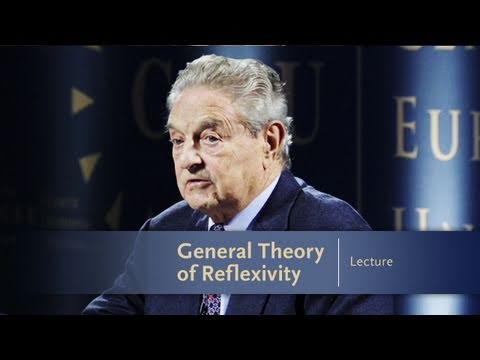
Soros rejected the efficient-market view. Participants' biased perceptions, he argued, influence the very fundamentals they're judging — a feedback loop ('reflexivity') that pushes prices far from equilibrium, then snaps back. Spot the loop, bet big when the odds are skewed, and stay humble enough to be wrong.1
3 The Method
Macro, reflexivity, and ruthless risk
Find the reflexive loop
Look for where perception is distorting fundamentals — an unsustainable peg, a bubble, a policy contradiction — and a reversal is building.
Bet big when skewed, asymmetrically
When conviction and odds align, size up — but structure the trade so being wrong is survivable.
Assume you're fallible
Treat every view as provisional and change your mind fast when the market disagrees — Popper's fallibilism applied to money.
A note on risk: Soros made enormous, leveraged macro bets backed by deep analysis and strict risk control. The lesson here is the thinking — reflexivity and asymmetry — not the size of the bets.
4 Try It Today
Test the idea for yourself
A no-risk exercise
Pick a past bubble or a currency/peg that eventually broke. Trace the feedback loop: how did rising prices (or a defended peg) change the behaviour that was supposed to justify them — until it snapped? Practising that reflexive lens is Soros's real contribution.
5 In Their Words
George Soros, quoted
"It's not whether you're right or wrong that's important, but how much money you make when you're right and how much you lose when you're wrong."— widely attributed to George Soros1
A note on sourcing: this maxim is closely associated with Soros (and his partner Stanley Druckenmiller) through interviews; we flag the attribution rather than a single verified transcript.
6 The Books & Their Big Ideas
What they wrote — and what to take from it
7 Watch & Read
Go deeper
- CONCEPTRisk & Position Sizing
- BOOKThe Alchemy of Finance
- READ"George Soros" — Wikipedia.1
§ Sources
- "George Soros," Wikipedia — en.wikipedia.org/wiki/George_Soros
- George Soros, The Alchemy of Finance (1987) — his statement of reflexivity.