1 The Edge — why it works
Two averages and a broken structure beat a lucky guess
Dow Theory says a trend is presumed intact until the weight of evidence says otherwise — and that the major averages must confirm each other. When one index makes a new high but a related one fails to (a divergence), and price then breaks a key structural level on volume, the odds of a real trend change rise sharply.
This isn't a precise entry trigger so much as a high-quality filter: it keeps you out of countless false turns and gets you positioned when the evidence actually stacks up. Fewer signals, but better ones.
2 Where it works — and doesn't
Conditions matter more than the pattern
Works best when…
- Two genuinely related averages or assets you can compare (e.g. an index and its transports, or a sector and its leader).
- A clear divergence — one makes a new extreme, the other doesn't.
- A clean structural level (the last higher low / lower high) to break.
- Volume expands in the direction of the break.
Fails / avoid when…
- Comparing unrelated markets — the 'confirmation' is meaningless.
- Range-bound chop with no real trend to change.
- Acting on the divergence alone, before any structural break.
- Thin, news-driven spikes you can't define a level against.
3 Setup checklist
All true before you act
- ✓Two related averages. You've chosen indices/assets that should move together.
- ✓A divergence. One makes a new high/low; the other fails to confirm it.
- ✓A structural break. Price breaks the last significant higher low (for a top) or lower high (for a bottom).
- ✓Volume agrees. Participation expands in the direction of the break.
4 The process
From signal to managed trade
Entry
Enter in the direction of the break — once price closes beyond the last structural pivot, with the averages diverging behind it. The break is the trigger; the divergence is the context.
Stop (1R)
Place the stop beyond the most recent swing that the break invalidated (e.g., above the last lower high for a short). That distance is your 1R.
Position size
Risk a small fixed % per trade; trend-change trades can need room, so size down to keep 1R small in dollars.
Exit & management
Treat it as a trend trade: trail the stop behind each new swing as the new trend develops, and exit when the averages confirm a turn back the other way.
5 Worked example (illustrative)
One trade, start to finish, in R
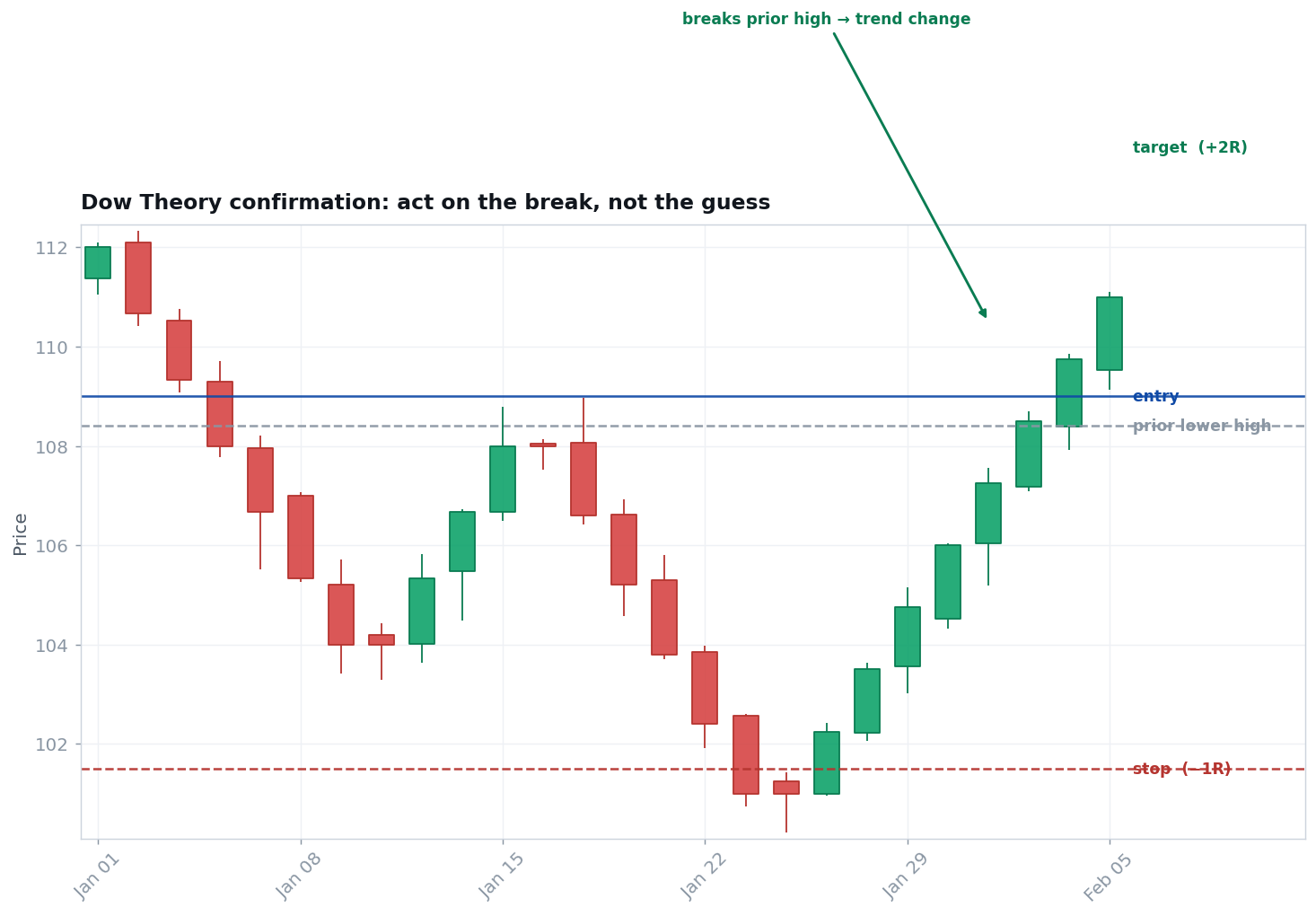
| Account / risk per trade | $25,000 · 1% = $250 |
| Entry (break of last higher low) | 100.0 (index pts) |
| Stop (above last lower high) — 1R | 104.0 · 1R = 4.0 pts |
| Position size = $250 ÷ (4.0 × $/pt) | sized to 1R |
| Target (prior structure / 3R) | 88.0 (+3R) |
| If it works: +3R | + $750 (≈ +3.0%) |
| If it fails: −1R | − $250 (≈ −1.0%) |
6 Honest expectancy
Fewer signals, higher conviction
Because it waits for divergence and a confirmed break, this filter trades rarely — but each signal carries real weight of evidence, which is the whole Dow-Theory idea. You trade quality, not quantity.
Example: win 40% at +3R, lose 60% at −1R → (0.40 × 3) − (0.60 × 1) = +0.6R per trade. Positive across many trades — but trend-change calls are hard and judgment-heavy. This is an expectation, never a guarantee.
7 Make it yours
Test before you trade
A no-risk validation routine
Pick a major index and a related average. Scroll history for past major tops and bottoms, and for each, mark the divergence and the structural break that followed. Note where the signal was clean and where it was ambiguous (Dow theorists often disagree — that's the honest hard part). Record results in R and compute expectancy before risking money.
8 Common mistakes
How traders blow this up
- Acting on divergence alone. Divergence can persist for a long time — wait for the structural break.
- Comparing unrelated markets. 'Confirmation' between things that needn't move together is noise.
- Fighting a still-intact trend. Until the evidence stacks up, the existing trend gets the benefit of the doubt.
- Stops too tight for the timeframe. Trend-change trades on daily/weekly charts need room; size down instead.
- Over-trading. This is a rare, high-conviction filter — forcing signals defeats its purpose.
Sources (free / verified)
1. William Peter Hamilton, The Stock Market Barometer (Harper, 1922) — public-domain full text (Internet Archive). 2. Robert Rhea, The Dow Theory (Barron's, 1932) — the systematization. Profiles: Dow · Hamilton · Rhea.