1 The Edge — why it works
Markets auction around value and reject prices that find no business
The Market Profile organizes a session into a distribution: a wide value area (about 70% of the trade) around the point of control (POC), the most-traded price. Steidlmayer's auction logic says price probes above and below value to advertise opportunity — and when an extreme finds no new business, it gets rejected and rotates back toward value. The fade trades that rotation: short a failed probe above value-area high, long a failed probe below value-area low, targeting the POC.
This is a balance-day tool. It works when the market is rotating inside a range — and it is dangerous on a trend day, when price leaves value and keeps going (an imbalance) rather than rotating back.
2 Where it works — and doesn't
Conditions matter more than the pattern
Works best when…
- A balanced, rotational session (not a trend day).
- A well-formed value area and a clear POC.
- A probe outside value that stalls and is rejected.
- Liquid markets with a meaningful profile (index futures, large ETFs).
Fails / avoid when…
- A trend / imbalance day — price leaves value and runs.
- A thin or one-sided profile with no real value area.
- Fading a powerful breakout on heavy volume.
- No acceptance back inside value to confirm the rejection.
3 Setup checklist
All true before you act
- ✓A defined value area. A clear VAH, VAL, and POC from the developing or prior profile.
- ✓A balanced session. The context is rotational, not a one-directional trend day.
- ✓A rejected probe. Price pokes outside value and fails to find new business, turning back.
- ✓Acceptance back inside. Price re-enters the value area, confirming the rotation toward POC.
4 The process
From signal to managed trade
Entry
Fade the rejected extreme — short as price re-enters value below the VAH (or long back above the VAL).
Stop (1R)
Just beyond the probe's extreme (above the rejected high for a short). Distance = 1R.
Position size
Risk a small fixed % of the account; shares = risk ÷ 1R.
Exit & manage
Target the POC (or the opposite side of value). It is a rotation trade — take the move; stand aside if a trend day develops.
5 Worked example (illustrative)
One trade, start to finish, in R
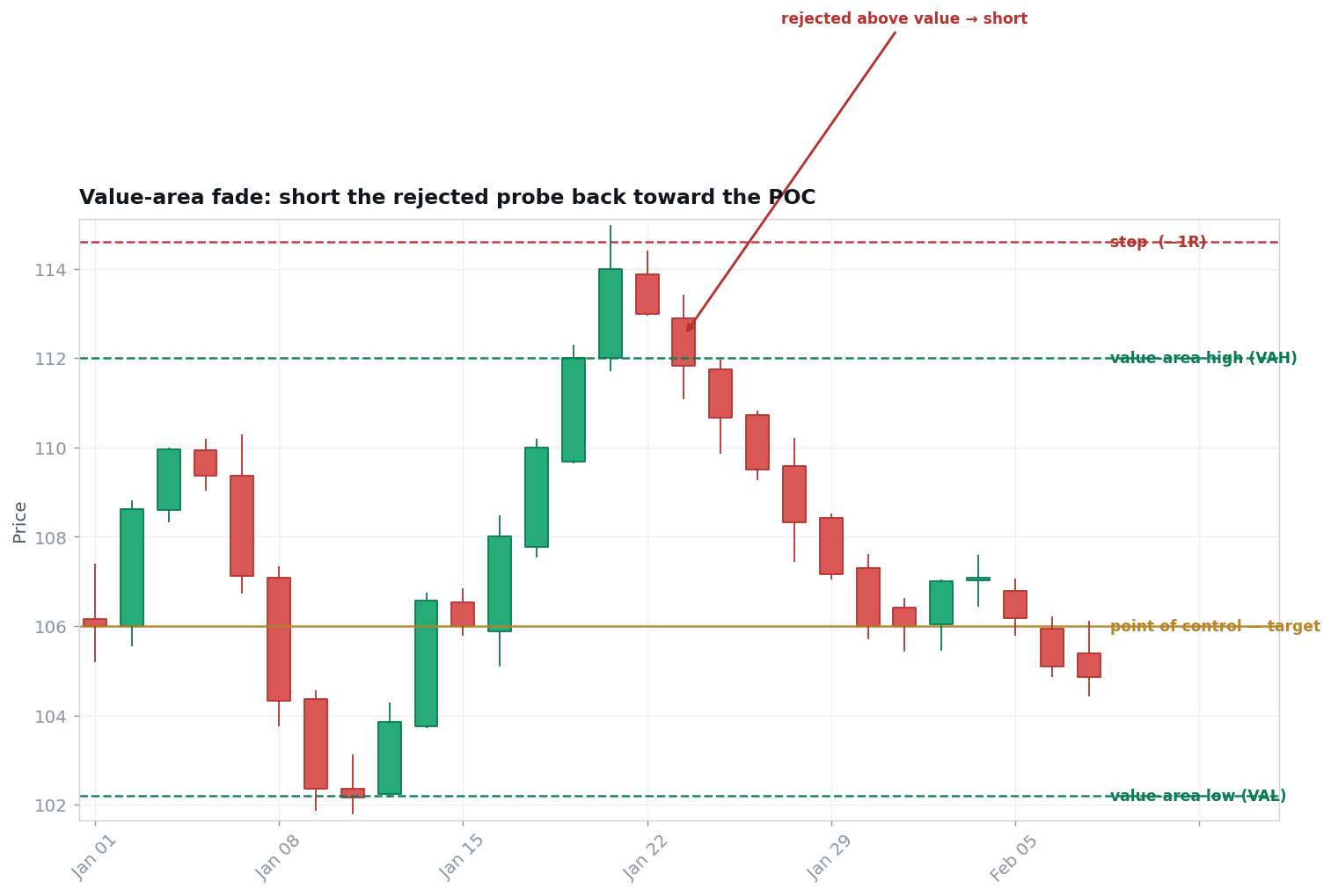
| Account / risk per trade | $25,000 · 1% = $250 |
| Value-area high (VAH) | $452.00 |
| Entry (re-enter value below VAH, short) | $451.50 |
| Stop (above rejected high) — 1R | $453.00 · 1R = $1.50 |
| Position size = $250 ÷ $1.50 | ≈ 166 units |
| Target (POC, ≈ +2R) | $448.50 |
| If it works: +2R | + $498 (≈ +2.0%) |
| If it fails: −1R | − $249 (≈ −1.0%) |
6 Honest expectancy
Higher win rate on balance days
Fading rotations back to value tends to win often, with modest targets — you are catching a return to the mean, not a trend. The danger is concentrated: a trend day can hand back several wins at once if you keep fading.
Example: win 60% at +1.5R, lose 40% at −1R → (0.60 × 1.5) − (0.40 × 1) = +0.5R per trade. Misread a trend day as balance and the edge inverts. An expectation, never a guarantee.
7 Make it yours
Test before you trade
A no-risk validation routine
On an index future or large ETF, add a volume- or market-profile tool and mark the VAH, VAL, and POC each session. Find every probe outside value that was rejected, and record the fade entry, the stop beyond the extreme, and the rotation to POC in R — before revealing the outcome. Tag each day balance vs. trend; you will see exactly when the fade works and when it is a trap.
8 Common mistakes
How traders blow this up
- Fading a trend day. On an imbalance day price leaves value and runs — this is where faders blow up.
- No real value area. A thin, one-sided profile has no mean to revert to.
- Entering on the poke. Wait for rejection and acceptance back inside value, not the first touch.
- Stops inside the probe. Place the stop beyond the rejected extreme, not in the noise.
- Over-fading. If price keeps accepting outside value, stop fighting it — the auction has moved.
Sources (free / verified)
1. Dalton, Jones & Dalton, Mind Over Markets (1990/2013) — value-area logic (paraphrased); free breakdown: book page. 2. CBOT Six-Part Study Guide to Market Profile (free). 3. The full framework: the Reading the Auction course and profiles Steidlmayer · Dalton. Market Profile® is a registered mark of CME/CBOT.